

9.9 kW Grid Tie Solar Power System With Battery Backup
A 9.9 kW solar array may fit a California home with substantial electricity use, but the nameplate number is only the starting point. Roof orientation, shade, panel wattage, utility territory, household loads, and your backup goals determine what the finished system can actually deliver.
Request a site-specific solar and battery design from Sun Solar Pros.
A 9.9 kw grid tie solar power system with battery backup can generate daytime electricity. Send excess energy to the grid, and store some solar power for evening use or selected circuits during an outage. The right design depends on modeled production, roof conditions, utility rules, and the loads you want to protect.
This guide explains the practical planning questions behind a 9.9 kW system. You will see how panel count and roof space are estimated, and why inverter architecture matters. You will also learn how to compare critical-load and whole-home backup, plus why California’s NEM 3.0 rules make energy timing important.
What Does a 9.9 kW Solar System Produce?
A 9.9 kW system’s annual production is a site-specific estimate, not a guaranteed output. Sun Solar Pros models sunlight, roof direction, shade, equipment, and expected losses against the home’s usage history. The result is more useful than applying one statewide production number to every California roof.
The 9.9 kW label describes nameplate capacity. It is the maximum rate of electricity the array is designed to produce under defined test conditions. It does not mean the system makes 9.9 kilowatt-hours every hour, or that it produces the same amount every day.
Production normally changes from morning to afternoon and from summer to winter. Clouds, high temperatures, dust, shading, and equipment losses can reduce output. A south-facing roof may have a different production pattern from an east- or west-facing roof. A chimney, tree, neighboring building, or roof vent can also affect the usable array area.
To estimate annual energy, a designer combines the 9.9 kW capacity with local solar conditions, roof geometry, orientation, tilt, shading, equipment, and expected system losses. The estimate should then be compared with at least 12 months of utility bills or interval data. That comparison helps show whether the array is likely to offset a meaningful share of consumption.
Usage offset is not the same as energy independence. A household with daytime consumption may use more solar as it is generated. Another household may use most of its electricity after sunset. Air conditioning, electric heating, a pool, a well pump, an electric water heater, or an electric vehicle can increase demand beyond what a standard system-size label suggests.
A grid-tied system uses solar energy in real time and draws from the utility when the home needs more power than the array is producing. Excess generation may flow to the grid under the applicable utility tariff. The U.S. Department of Energy’s solar-plus-storage overview explains how storage can make daytime generation available after the sun goes down. A battery improves control and backup capability, but it does not create additional solar production.
How Many Panels and How Much Roof Space Does 9.9 kW Need?
Panel count depends on module wattage. For example, 400-watt modules require about 25 panels to reach 9.9 kW, while 330-watt modules require about 30. Sun Solar Pros must still check module dimensions, setbacks, roof obstructions, shade, and access before confirming a buildable layout.
The basic planning formula is simple: divide 9,900 watts by the wattage of the selected panel, then round to a practical design. The result is an illustration, not a quote or a promise that every panel will be available for your home.
- 400-watt panels: 9,900 divided by 400 equals 24.75, so a design may use about 25 panels.
- 375-watt panels: 9,900 divided by 375 equals 26.4, so a design may use about 27 panels.
- 350-watt panels: 9,900 divided by 350 equals 28.3, so a design may use about 29 panels.
- 330-watt panels: 9,900 divided by 330 equals 30, so a design may use about 30 panels.
- Higher-wattage modules: A higher panel wattage can reduce the module count, but physical size, performance, availability, and roof layout still matter.
Panel count is only part of the roof-footprint question. The installer must consider each module’s dimensions, row spacing, roof edges, ridgelines, valleys, fire-access pathways, vents, skylights, chimneys, and electrical routing. A roof that looks large from the ground may have less usable area after those constraints are mapped.
Panel efficiency can also matter when roof space is limited. Higher-efficiency modules may produce more power in a smaller footprint, while a different panel may offer a better fit for a specific budget or layout. Homeowners can compare technology considerations in this guide to the best solar panels for a home.
Tile roofs need additional care, but tile does not automatically rule out a 9.9 kw grid tie solar power system with battery backup. The site survey should review tile condition, attachment points, roof transitions, weather protection, and safe access. It should also identify whether roof work or replacement needs to happen before the solar installation.
A final layout should come from a property-specific design. That design can confirm panel dimensions, roof planes, shade, structural considerations, equipment locations, wiring routes, and permitting requirements. It converts the useful panel-count math above into a plan that can actually be reviewed with the homeowner.
How Does a 9.9 kW Grid Tie Solar Power System With Battery Backup Work?
A grid-tied solar-plus-storage system uses an inverter to convert solar electricity for the home, utility grid, and battery. During an outage, backup equipment disconnects the home from the grid and powers the selected loads. Sun Solar Pros designs the inverter and controls around the array, battery, and electrical panel.
Solar panels produce direct-current electricity. An inverter converts that electricity into alternating current for household use and, when permitted, export to the utility grid. A standard grid-tied inverter relies on the grid as its electrical reference. When the grid goes down, it normally shuts off even if the panels are in sunlight.
That shutdown protects utility workers from unexpected power on lines they believe are de-energized. It is why panels alone should not be described as outage backup. To keep selected household circuits operating, the system needs backup-capable equipment that can isolate the home from the utility.
A battery system may use a hybrid inverter or a coordinated inverter, transfer, and backup-gateway arrangement. During normal operation, solar energy can serve the home, charge the battery, or flow to the grid. During an outage, the backup equipment forms a controlled local electrical network. The exact behavior depends on the equipment, settings, utility requirements, and loads included in the design.
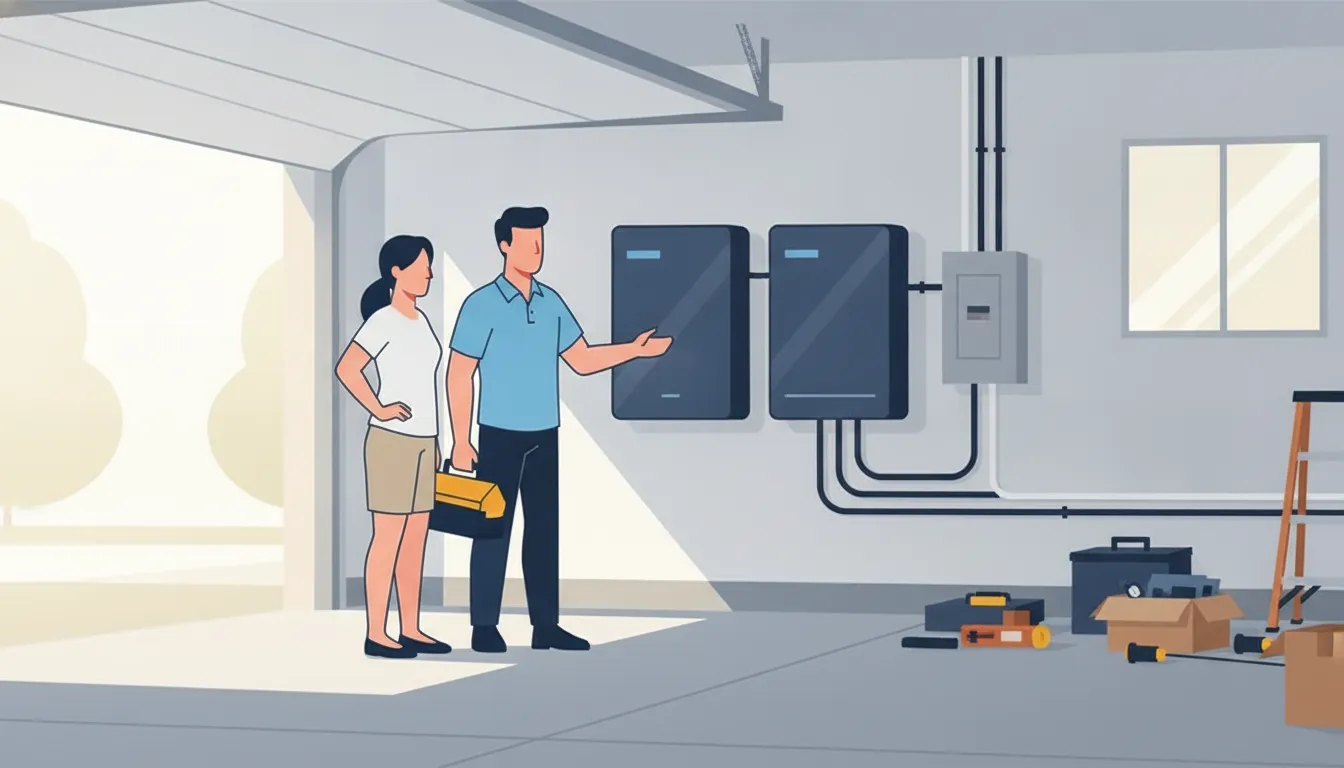
What does the inverter need to handle?
The inverter must be compatible with the panel array, battery, electrical service, monitoring system, and backup equipment. It also needs enough output power for the loads that may run at the same time. A battery can have plenty of stored energy but still be unable to start a large motor or serve several high-demand appliances together if its output rating is too low.
What happens when the grid goes down?
The system should disconnect the designated backup loads from the utility before supplying them. Critical-load designs often prioritize refrigeration, lighting, internet equipment, medical devices, and selected outlets. Whole-home designs may support more circuits, but large HVAC systems, pumps, electric water heating, pool equipment, and EV charging can quickly increase the required power and stored energy.
Homeowners who already have solar should confirm compatibility before assuming a battery can simply be added. The battery, inverter, panel-level electronics, electrical panel, and monitoring controls may all affect the retrofit. Sun Solar Pros explains that equipment review in this guide to adding a battery to an existing SunPower system.
How Should You Size the Battery for Critical or Whole-Home Backup?
Battery size should follow the home’s evening use and outage priorities, not the 9.9 kW panel rating alone. A critical-load plan can focus on essential circuits. A whole-home plan requires more output and stored energy. Sun Solar Pros evaluates both sustained consumption and appliance startup demand before recommending an approach.
Battery sizing involves two separate questions. First, how much power must the battery deliver at one time? Second, how much energy must it store over the backup period? Power is measured in kilowatts. Energy capacity is measured in kilowatt-hours. Both matter when deciding whether the system can run a refrigerator, lights, a pump, medical equipment, or air conditioning.
| Backup approach | Typical goal | Main design question |
|---|---|---|
| Critical-load backup | Keep selected essentials operating during an outage. | Which circuits are essential, and how long should they run? |
| Whole-home backup | Support most or all household circuits when equipment allows. | Can the system handle large starting loads and sustained demand? |
Start with the loads that matter most to your household. Refrigeration, lighting, internet, medical equipment, and a garage door may be priorities. Central air conditioning, electric resistance heat, a well pump, pool equipment, and EV charging may require substantial power or load management. Those appliances do not automatically make backup impossible, but they change the design.
Review evening use as well as outage use. Solar production falls after sunset, which is when many households cook, cool the home, use electronics, and charge devices. A year of bills shows total consumption, but interval data can better reveal when demand occurs. The installer may also need appliance ratings and information about motor startup requirements.
Some homeowners begin with a critical-load panel and leave room for future expansion. If that is your preference, the original design should consider compatible equipment, wall or floor space, electrical capacity, and future loads such as an EV or heat pump. Sun Solar Pros offers home battery storage options that can be evaluated against the property’s equipment and backup goals.
For more examples of how household appliances affect backup planning, review the guide to battery backup for home appliances. The important point is not to select a battery by panel size alone. The array, inverter, battery, panelboard, controls, and intended loads must work as one system.
Talk with Sun Solar Pros about a battery plan matched to your home’s critical loads.
How Does NEM 3.0 Change the Value of Solar Plus Storage?
California’s NEM 3.0, also called the Net Billing Tariff, makes timing more important in solar planning. A battery can store some daytime solar for later household use, while the utility relationship governs exported energy. Sun Solar Pros models the home, utility territory, rate plan, and storage goals together instead of relying on a generic payoff claim.
Under a grid-tied arrangement, the home can use solar as it is produced. If generation is greater than demand, excess power may be exported under the applicable tariff. If the home needs more electricity than the array is producing, it draws from the grid or, when available and permitted by the operating mode, from the battery.
Many homes use more electricity in the late afternoon and evening, after the strongest solar production has passed. A battery can shift some daytime generation into that later period. Smart controls may also direct flexible loads, such as pool equipment or EV charging, toward times when solar is available.
NEM 3.0 does not produce one identical result for every California homeowner. Utility territory, tariff, rate schedule, interconnection requirements, roof conditions, annual usage, and financing structure all affect the design. A plan for a PG&E customer may not have the same operating priorities as a plan for a homeowner served by SCE or another California utility.
The California Public Utilities Commission NEM guidance is the appropriate place to review current state-level information. Incentive rules can also change, so homeowners should review solar incentives separately and confirm eligibility before treating an incentive as part of a personal financial decision.
For a 9.9 kw grid tie solar power system with battery backup, the practical question is not simply how much electricity the roof can produce. It is how much energy the home can use directly, how much can be stored, what may be exported, and which loads should remain available during an outage. Those answers require a site-specific model rather than a universal savings promise.
Is a 9.9 kW Grid Tie Solar Power System With Battery Backup Right for Your California Home?
A 9.9 kW grid tie solar power system with battery backup may fit a higher-use California home with suitable roof space and a clear need for evening energy or outage resilience. Sun Solar Pros compares 12 months of usage, future loads, roof production, utility rules, and backup priorities before recommending this size.
- Gather usage history: Collect at least 12 months of utility bills and note seasonal changes. Include planned electrification, home additions, or changes in occupancy.
- List major loads: Identify air conditioning, heating, pumps, pool equipment, water heating, refrigeration, medical devices, and EV charging. Separate continuous demand from motor startup demand.
- Review the roof: Check usable roof planes, orientation, shade, tile condition, setbacks, vents, skylights, and access. Roof area should be measured, not estimated from the ground.
- Confirm the utility plan: Identify your utility, rate schedule, export rules, interconnection requirements, and time-of-use periods. These details influence battery operation and self-consumption.
- Choose the backup boundary: Decide whether the goal is selected essential circuits or broader whole-home support. The answer affects the inverter, panelboard, controls, and battery capacity.
- Compare equipment as a system: Review panel wattage, inverter architecture, battery compatibility, monitoring, warranty terms, and service support together. A single specification cannot predict the finished result.
When might a smaller system make sense?
A smaller array may be more practical when annual usage is modest, usable roof space is limited, or shade affects too much of the roof. It may also make sense when the homeowner wants to address only a portion of current consumption and does not expect major new electrical loads.
When might a larger system make sense?
A larger system may deserve review when the home has high annual consumption, is adding electric appliances, or has sufficient unshaded roof area. The utility, structural conditions, equipment limits, and permitting requirements still determine what can be proposed. Bigger is not automatically better if the production cannot be used effectively.
The most useful design conversation connects the array to the home. Share your bills, roof information, outage concerns, equipment list, and future plans. Sun Solar Pros can then explain what a 9.9 kW design may cover, where its limits are, and whether another system size would better match the property.
Request a custom residential solar and battery design from Sun Solar Pros.
Frequently Asked Questions
How much power does a 9.9 kW solar system produce?
A 9.9 kW system’s actual production depends on roof orientation, shade, sunlight, temperature, equipment, and local weather. The 9.9 kW label describes rated capacity, not guaranteed daily output. Sun Solar Pros can compare a site-specific production estimate with your utility history.
Can you have a grid-tied solar system with battery backup?
Yes. A backup-capable inverter and transfer equipment can isolate selected home circuits from the utility during an outage. Solar and the battery can then serve those circuits within the system’s power and energy limits. A standard grid-tied inverter alone normally shuts down when the grid fails.
How large should the battery be for a 9.9 kW system?
Battery size should be based on evening consumption, outage priorities, appliance startup demand, and the length of backup desired. Critical-load backup may focus on selected essentials. Whole-home backup requires more output and stored energy, especially when HVAC, pumps, or EV charging are included.
Is grid-tie solar worth considering under California NEM 3.0?
The answer depends on your utility, rate plan, usage schedule, roof, system design, financing, and backup goals. NEM 3.0 makes self-consumption and storage planning more important, but no generic answer can replace a home-specific production and usage analysis.
Get Started With a Site-Specific Solar Design
A 9.9 kW grid tie solar power system with battery backup can look different from one California home to the next. The correct panel count, roof layout, inverter, battery, backup circuits, and operating strategy depend on the property and the household.
Sun Solar Pros provides residential solar and battery planning for homeowners who want to understand those tradeoffs before choosing a system. Bring your recent utility bills, roof concerns, appliance list, and outage priorities to the conversation.
Call Sun Solar Pros at 661-379-7000 to request a custom solar and battery design.