

Cost to Install Solar Panels on a Tile Roof in California
Cost to Install Solar Panels on a Tile Roof in California
Tile roofs are compatible with solar, but they require a more careful installation plan than composition shingles. The cost to install solar panels on a tile roof depends on system size. Tile handling, mounting hardware, electrical work, permits, roof condition, and whether repairs or reroofing are needed.
Ready to review your tile roof? Call Sun Solar at 661-379-7000.
What Is the 2026 Cost to Install Solar Panels on a Tile Roof?
A reasonable 2026 California planning range is $2.50 to $3.50 per watt for a standard solar system before batteries and roof work. Tile handling may add $0.30 to $0.60 per watt. On an 8 kW system, that is roughly $20,000 to $28,000 for solar plus $2,400 to $4,800 for tile-specific work.
These are planning benchmarks, not a Sun Solar quote. The August 2026 update to EnergySage’s California solar cost data reports an average of $2.52 per watt for installed solar before incentives. That provides a useful market reference for the base-system range. An in-person assessment is necessary because a concrete tile roof, a Spanish clay tile roof, and a roof with aging underlayment can produce very different scopes. Sun Solar’s residential solar team can evaluate the roof, energy use, array layout, and project assumptions together.
For a California homeowner, the most useful way to budget is to separate the solar system from the roof-specific work. Solar equipment and standard installation are usually priced by system size. Tile work is then added for careful removal, protected storage, mounting access, replacement tiles, flashing, and reinstallation. Roof repairs, electrical upgrades, and batteries should also appear as separate line items.
For an illustrative 2026 California budgeting exercise, use $2.50 to $3.50 per watt before a battery and roof work. A 6 kW example is $15,000 to $21,000. An 8 kW example is $20,000 to $28,000. A 10 kW example is $25,000 to $35,000. These are Sun Solar planning examples, not published market averages or offers. Equipment tier, utility requirements, financing, roof design, and electrical scope can move the final figure.
| System size | Standard panel-and-install benchmark | Illustrative tile-work premium | Planning subtotal |
|---|---|---|---|
| 6 kW. | $15,000-$21,000. | About $1,800-$3,600. | About $16,800-$24,600. |
| 8 kW. | $20,000-$28,000. | About $2,400-$4,800. | About $22,400-$32,800. |
| 10 kW. | $25,000-$35,000. | About $3,000-$6,000. | About $28,000-$41,000. |
The tile-work column uses an illustrative premium of $0.30 to $0.60 per watt. It is intended to help a homeowner recognize whether a quote has accounted for specialized tile labor. For a separate public cost reference, EnergySage tracks solar pricing data in its solar panel cost guide. That broader reference does not price a specific tile roof or replace a site evaluation. It is not a fixed industry fee. A small, accessible roof with matching spare tiles may fall near the lower end. A steep roof with fragile clay tiles, difficult rafter access, or extensive flashing work may fall higher.
These subtotals do not include a battery, main-panel upgrade, trenching, reroofing, major structural repair, or financing costs. Homeowners comparing incentives can review Sun Solar’s residential solar incentives information separately. Under California’s current utility-rate environment, many homeowners also compare solar-plus-storage options. Review the equipment and roof scope separately in a written proposal, then compare the same scope across installers. Sun Solar’s California solar panel cost guide offers additional context for the system portion of the budget.
Why Does a Tile Roof Cost More Than Composition Shingles?
Tile roofs cost more because installers must lift and protect individual tiles, reach structural attachment points, install flashing, and refit or replace pieces around each mount. Concrete and Spanish clay tiles can crack under pressure, so careful handling and specialized mounting add labor compared with composition shingles.
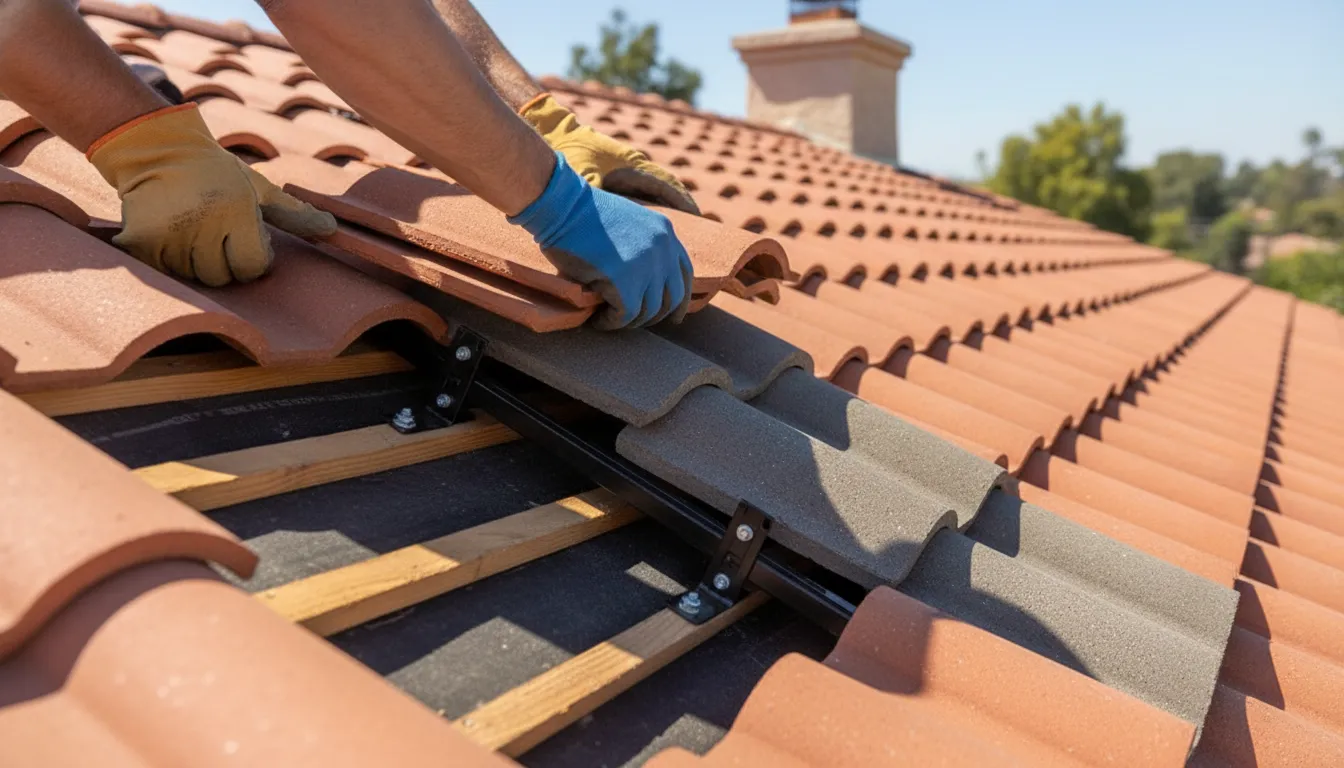
Tile increases the labor and risk-management portion of a solar project. Composition shingles can usually be cut and sealed around a flashed attachment point. Concrete and clay tiles are individual roof pieces that can crack when stepped on, lifted incorrectly, or pressed against mounting hardware. The crew must preserve the roof’s water-shedding design while creating a secure attachment for the solar array.
How much do tile removal and replacement add?
Installers may remove selected tiles to reach the roof deck and rafters. The tiles must be lifted without damaging overlapping pieces, placed somewhere safe, and returned in the correct order. Some tiles need a notch or relief cut so they sit flat around a mount. Others may be too brittle to reuse and need replacement.
The number of attachment points is one cost driver. A larger array usually needs more racking and more roof connections. Roof geometry also matters. Multiple roof planes, valleys, dormers, steep slopes, and limited staging areas can slow the work. Ask the installer whether the proposal includes an allowance for broken or unavailable matching tiles.
What mounting hardware is used on tile?
Solar installers commonly discuss tile hooks, tile-replacement mounts, and comp-out sections. A tile hook reaches beneath or around a tile while its base attaches to the structural roof framing. A tile-replacement mount takes the place of a removed tile and can provide a cleaner transition at the attachment point. A comp-out section replaces a small area of tile with composition shingles so conventional flashed mounts can be used.
There is no universally best method. The right choice depends on the tile profile, roof structure, underlayment, rafter layout, array design, and water-management details. The proposal should identify the mounting approach, attachment points, flashing method, sealants, and responsibility for any tile damage. A lower initial price is not a good value if it leaves the homeowner unclear about leak prevention or future repairs.
How do permits affect the tile-roof solar budget?
California permitting and inspection requirements can vary by city and utility territory. A project may require building review, electrical review, structural documentation, inspection, and utility interconnection steps. Roof work can add another layer of coordination. The Lawrence Berkeley National Laboratory’s research on residential solar permitting explains why local processes can influence installation time and price.
Permits may not be the largest part of the total, but delays can affect scheduling and labor coordination. Ask which permits are included, who submits them, who pays the fees, and how revisions are handled. A transparent quote separates permits from tile work instead of hiding every contingency in one total.
Do You Need to Replace a Tile Roof Before Installing Solar?
No. A sound tile roof can usually receive solar after selected tiles are lifted and replaced around properly flashed mounts. Consider a re-roof first when the underlayment is failing, leaks are recurring. Tiles are broadly brittle, or the roof may need major work during the solar system’s service life.
Not automatically. A tile roof does not need to be replaced solely because solar panels are being added. The decision depends on the roof’s remaining service life, tile condition, underlayment, flashing, deck, rafters, and history of leaks. A sound roof may only need selective tile removal and replacement.
Roof age alone is not enough to make the decision. A relatively young roof can have concealed water damage or brittle tiles. An older roof can still be a good candidate if the underlayment and structure are sound. The evaluation should distinguish between a roof that needs a small repair and a roof that may require major work during the solar system’s service life.
When is a targeted repair enough?
A targeted repair may be appropriate when the roof is generally sound and the problem is limited. Examples include a small number of broken tiles, a defined flashing issue, or a localized underlayment repair. If an existing solar system also needs service, Sun Solar’s solar repair service is a related resource. The contractor should document the affected area, explain whether panels will cover it, and identify who completes the roofing work.
This approach can avoid paying for a full reroof when the existing roof has substantial useful life remaining. It also keeps the solar scope easier to compare. Request separate pricing for the repair, tile replacement allowance, and solar installation.
When is reroofing the better choice?
Reroofing deserves serious consideration when the roof has widespread brittleness, recurring leaks, deteriorated underlayment, sagging areas, or a history of repeated patching. It may also make sense when the roof is near the end of its practical service life. Installing solar first can create future removal and reinstallation costs if a reroof becomes necessary soon afterward.
For a broad 2026 budgeting exercise, use $18,000 to $35,000 as an illustrative example for roofing-only work on a concrete or clay tile home. A simpler roof may cost less. A large, steep, complex, or damaged roof can cost more. A Southern California roofing guide published by US Power Roofing reports a higher full-replacement range of about $15 to $25 per square foot. With tile re-lay work around $10 to $15 per square foot. Its 2026 tile-roof pricing guide provides a third-party regional reference, not a Sun Solar quote. The $4 to $12 per square foot figure is another rough planning example, not a published market average. Actual scope, tile type, tear-off, underlayment, access, and local labor market control the price.
Do not add the roofing benchmark automatically to every solar project. Ask for a roof inspection and a written comparison of repair, selective replacement, and full reroofing. Review the roofing warranty and solar warranty together, especially around penetrations, flashing, future service, and panel removal.
What Changes the Cost to Install Solar Panels on a Tile Roof?
The biggest cost variables are system size, tile handling, mounting and flashing, roof condition, electrical upgrades, permits, and battery storage. A detailed quote should separate the base solar system from tile work, repairs, reroofing, and optional equipment so you can compare the same scope across installers.
The full project budget should contain more than a panel count and a monthly payment. Use these categories to check whether an estimate reflects the actual work required at your home.
| Category | Possible scope | Question to ask |
|---|---|---|
| Solar equipment | Panels, inverter or microinverters, racking, monitoring, design, and standard installation. | What system size and equipment are included, and is the price before or after incentives? |
| Tile handling | Removal, protected storage, notching, replacement, staging, and reinstallation. | How many tiles are expected to be removed, and what allowance covers breakage? |
| Mounting and flashing | Roof attachments, structural connections, flashing, sealants, and water-management details. | Which method is proposed, and who is responsible for leak-related corrections? |
| Electrical work | Conduit, disconnects, grounding, main-panel work, trenching, and utility interconnection. | Are panel upgrades and inspection corrections included or optional? |
| Permits and inspections | Building review, electrical review, city fees, inspections, and utility paperwork. | Who submits each permit and what happens if plans need revision? |
| Roof work | Tile repairs, underlayment work, structural repair, selective replacement, or reroofing. | Is roofing performed by the solar contractor, a partner, or a separate roofer? |
| Battery storage | Battery equipment, backup-load design, electrical components, and installation. | Is storage optional, and is it priced separately from the solar array? |
Battery storage should be evaluated according to the home’s usage, outage priorities, utility rate structure, and export economics. It should not be used to hide the roof premium. If storage is part of the plan, compare a solar-only option with a solar-plus-storage option using the same roof and electrical assumptions. Sun Solar provides home battery storage planning as part of its broader energy approach.
Want a line-item tile-roof solar budget? Call Sun Solar at 661-379-7000 to schedule an evaluation.
Which Tile-Roof Mounting Method Is Best?
The best mounting method depends on the tile profile, roof structure, underlayment, pitch, and array layout. Tile hooks, tile-replacement mounts, and comp-out sections can all be appropriate in the right design. The installer should explain attachment points, flashing, tile handling, and leak protection before work begins.
The best mounting method is the one that provides a sound structural attachment and protects the roof’s water-shedding system. A method should not be selected only because it has the lowest hardware price. The installer should inspect the tile profile, underlayment, rafter layout, roof pitch, and array design before recommending a solution.
Tile hooks
Tile hooks use a metal bracket that connects to the roof structure and reaches around or beneath the tile. Selected tiles are lifted, the attachment is flashed, and the tile is fitted around the hardware. This can preserve much of the existing tile field, but the fit must be precise. A tile that rocks, bears pressure, or sits too high can crack or interfere with drainage.
Tile-replacement mounts
A tile-replacement mount takes the place of an individual tile at an attachment point. It can create a cleaner finished appearance and a purpose-built flashing transition. The tradeoff is additional product and labor cost. Removed tiles also need to be stored or used elsewhere, and the replacement piece must work with the existing roof profile.
Comp-out sections
A comp-out replaces a defined area of tile with composition shingles. A standard flashed solar mount can then be installed on the shingle section. This may simplify the attachment, but the transition between materials requires careful water management and a finished appearance that the homeowner accepts. It is not appropriate for every tile roof or array layout.
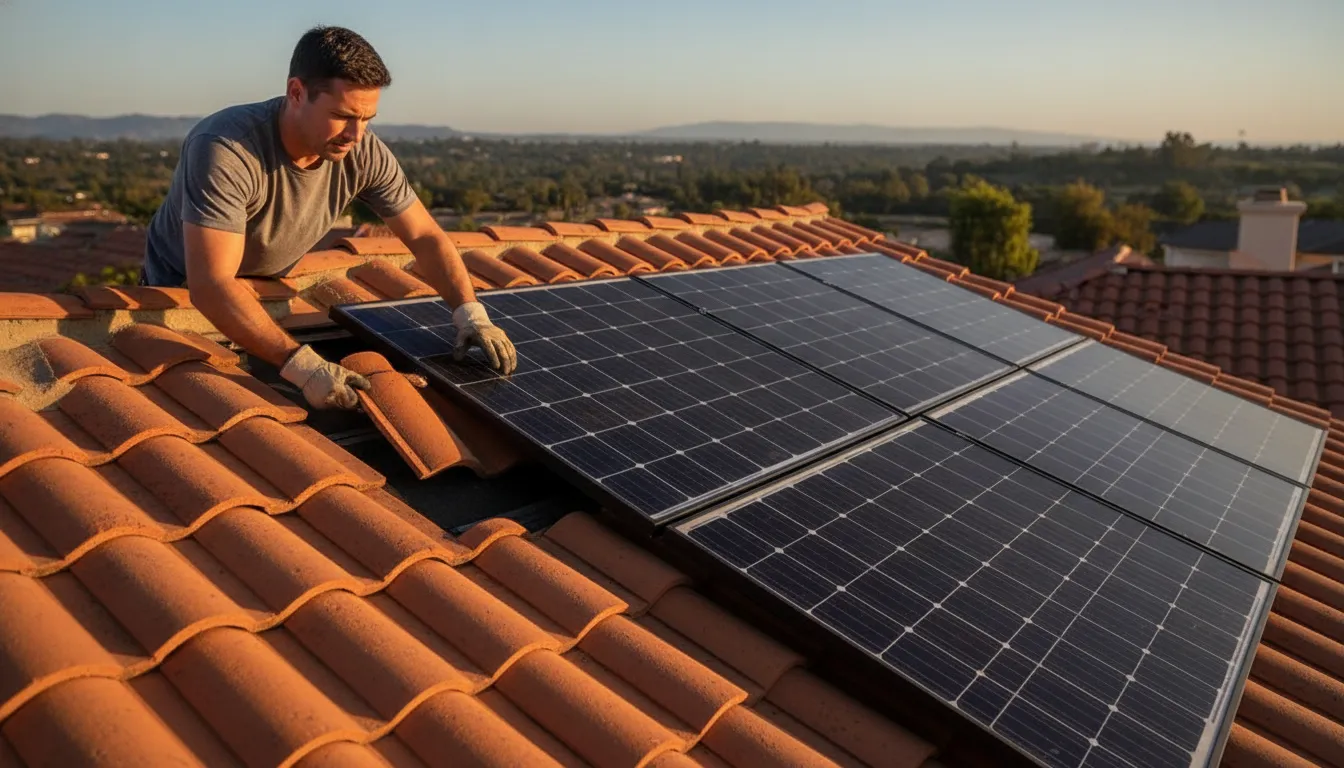
Ask for a drawing or clear written description of the proposed method. It should show where mounts are placed, how penetrations are flashed, which tiles are removed, how damaged tiles are handled, and what warranty covers the roof work. Sun Solar’s tile-roof solar guide provides additional background, but the final recommendation should be based on the home’s actual roof.
How Can You Avoid Surprise Tile-Roof Solar Costs?
You can reduce surprises by getting a roof assessment and a line-item proposal before approving solar. Confirm tile condition, replacement allowances, mounting method, electrical assumptions, permits, warranties, and whether repairs or reroofing are included. Compare solar-only and solar-plus-storage options with the same roof assumptions.
A detailed site evaluation and line-item proposal are the best defenses against an unexpected total. Before signing, work through this checklist.
- Confirm roof condition. Ask for an assessment of tiles, underlayment, flashing, deck, rafters, and visible leak history.
- Request a tile-handling plan. Confirm which tiles will be removed, how they will be stored, and how replacements will be sourced.
- Identify the mounting method. Ask whether the design uses hooks, tile-replacement mounts, comp-out sections, or a combination.
- Separate standard and roof-specific costs. The quote should distinguish the solar system, tile labor, mounting, electrical work, permits, repairs, and reroofing.
- Check electrical assumptions. Ask about main-panel capacity, conduit paths, grounding, trenching, and utility requirements.
- Compare battery options separately. Review solar-only and solar-plus-storage proposals without changing the roof assumptions.
- Review warranties together. Confirm who covers flashing, tile damage, leaks, panel removal, and future service access.
- Ask for a schedule. Include assessment, design, permits, installation, inspection, and utility approval milestones.
Installers should be comfortable explaining the roof work in plain language. Sun Solar has more than 18 years in business and provides residential system design, installation, and ongoing service. Its team can explain how concrete or clay tile affects the project, but experience does not replace an inspection. Homeowners can also review the company’s solar maintenance service when comparing long-term support. Experience does not replace an inspection, but it can help a homeowner compare the tradeoffs before approving a project.
Before you compare proposals, call Sun Solar at 661-379-7000 for a tile-roof evaluation.
Frequently Asked Questions
Can solar panels be installed on a concrete or clay tile roof?
Yes. Installers can remove selected tiles, connect mounts to the roof structure, flash the attachment points, and refit or replace tiles around the hardware. The plan must account for tile breakage, access, water management, and matching replacement pieces.
How much does it cost to install solar panels on a tile roof?
A rough 2026 California planning range is $2.50 to $3.50 per watt for a standard solar system before batteries and roof work. Tile-specific labor and mounting may add about $0.30 to $0.60 per watt. Repairs, electrical upgrades, permits, and reroofing can change the total substantially.
Does a tile roof need to be replaced before solar?
Not always. A sound tile roof may only need selective removal and replacement. Reroofing is worth considering when the roof has widespread brittleness, recurring leaks, failing underlayment, or limited remaining service life. A roof inspection should compare repair and replacement before the solar design is finalized.
Are solar panels more expensive on Spanish clay tile?
They can be. Spanish clay tiles are often more fragile and curved, which can require slower access, specialized mounting, careful flashing, and more replacement planning. The cost difference depends on the tile profile, roof condition, array size, attachment count, and installation method.
Schedule a Tile-Roof Solar Evaluation
A site-specific evaluation is the reliable way to price solar on a tile roof. Roof condition, tile type, array size, mounting, electrical work, permits, and reroofing needs vary from home to home.
The cost to install solar panels on a tile roof cannot be confirmed from a roof photo or a generic per-watt calculator. A site-specific evaluation can identify the roof condition, array size, mounting approach, electrical scope, permits, and whether repairs or reroofing belong in the project. Sun Solar serves California homeowners with residential solar design, installation, and battery planning.
Call Sun Solar at 661-379-7000 to discuss your tile roof and request an evaluation.